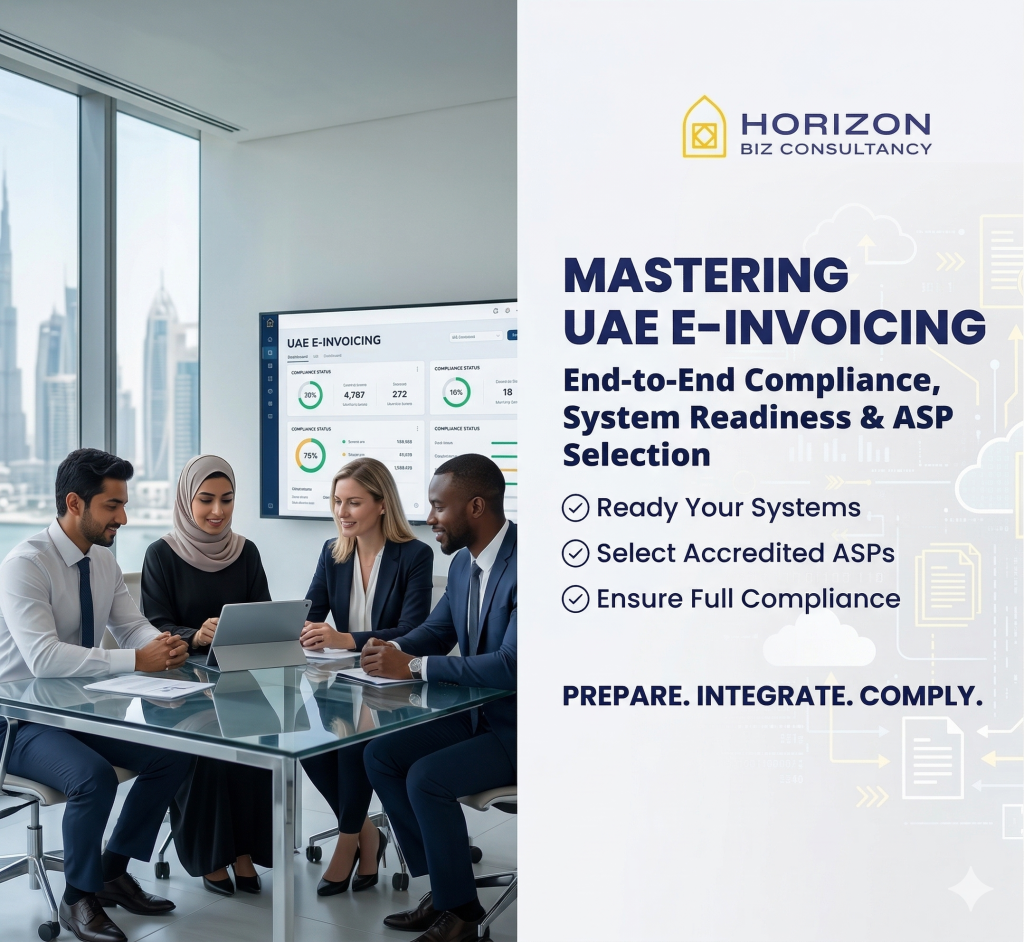
Mastering UAE E-Invoicing: End-to-End Compliance, System Readiness & ASP Selection
Essential Insights for UAE Businesses Preparing for Mandatory Electronic Invoicing
Learn everything you need to know about UAE’s Electronic Invoicing rollout – from mandatory field requirements and system readiness to choosing the right Accredited Service Provider.
9th April, 2026
4:00PM Onwards
Register For Free
Introduction
Let’s be clear UAE Electronic Invoicing isn’t something you can put off. It applies to every business operating in the UAE, VAT-registered or not. If your revenue exceeds AED 50 million, you’re looking at a January 2027 deadline. Everyone else has until July 2027. Either way, the time to act is now, not six months from now.
This webinar is designed to cut through the noise and give you a clear picture of what’s actually required and how to get there.
We’ll walk you through:
- Why waiting on your ASP selection is a risk you can’t afford
- Exactly which fields are required on Tax Invoices versus Commercial Invoices
- How the 5-Corner Model works and what happens to your invoice between your system and the FTA
- What to actually look for when evaluating an ASP beyond the marketing brochure
- How to handle the tricky scenarios like Free Zones, Deemed Supply, Margin Scheme, Exports, and E-Commerce
- And finally, a realistic roadmap so you know where you stand and what to do next
Whether you’re just getting started or already mid-way through your compliance journey, this session will help you move forward with clarity and confidence.

About the Speakers

CA Vibha Malik Modi
Co-Founder, Horizon Biz Consultancy | Chartered Accountant (ICAEW & ICAI)

CA Sunitha Cherian
Audit & Tax Manager
CA Vibha Malik Modi
Co-Founder, Horizon Biz Consultancy | Chartered Accountant (ICAEW & ICAI)
With over 15 years of experience across the UAE and global markets, Vibha Malik Modi brings a rare combination of technical depth and practical advisory insight. As a dual-qualified Chartered Accountant and Co-Founder of Horizon Biz Consultancy, she has advised 500+ businesses ranging from startups to multinational groups on VAT, corporate tax, compliance, and cross-border structuring.
Her strength lies in simplifying complex regulatory frameworks into actionable strategies for businesses. Whether it is VAT, corporate tax, or evolving compliance landscapes like e-invoicing, Vibha is known for her clarity-driven approach and ability to translate regulations into real business decisions.
She has been actively leading industry conversations around UAE tax transformation, helping businesses move from reactive compliance to structured readiness.
CA Sunitha Cherian
Audit & Tax Leader | UAE Compliance & Advisory Specialist
Sunitha Cherian is a seasoned tax and audit professional with deep expertise in UAE compliance frameworks and financial systems. Known for her hands-on approach, she works closely with businesses to bridge the gap between VAT, regulatory requirements, and operational execution.
Her experience spans across audit, VAT, tax advisory, and system-level implementation, making her particularly strong in areas where finance, technology, and compliance intersect. She has been closely involved in guiding businesses through evolving regulatory changes, with a focus on practical implementation, system readiness, and process alignment.
Sunitha is recognised for breaking down complex technical requirements into structured, actionable steps, helping businesses not just understand compliance, but execute it effectively.
Limited Seats: Master UAE E-Invoicing Before Implementation Begins
End-to-end compliance, system readiness, and ASP selection explained by experts.
Prepare early and stay ahead of UAE’s evolving E-Invoicing requirements.
What You'll Gain in This Power-Packed Session
This session is built around one goal you leave knowing exactly what to do and how to do it. Here’s what you’ll walk away with:
🧭 Clarity on who this actually applies to
UAE E-Invoicing covers every business B2B and B2G transactions are in scope. We’ll also cover what’s excluded (B2C, sovereign activities, exempt financial services, airline tickets) and how the rules apply to Tax Groups, holding companies, and non-UAE established persons.
📋 A clear breakdown of all 51 mandatory fields
- Invoice details
- Buyer/seller information
- Tax breakdown
- Line items XML format only no PDFs, no QR codes
You’ll also understand the difference between a Tax Invoice and a Commercial Invoice, the 6 invoice categories, and what switching to XML actually means for your ERP or accounting system.
⚡ Confidence handling the tricky scenarios
Free Zone, Deemed Supply, Margin Scheme, Summary Invoice, Continuous Supply, Agent Billing, E-Commerce, Exports we’ll walk through all 8 so nothing catches you off guard. Plus the tax categories you need to know: Standard Rate, Zero Rated, Exempt, Reverse Charge, Out of Scope, and Margin Scheme.
🗓️ Your exact deadline and what to do before it hits
- Pilot kicks off 1 July 2026 voluntary
- Revenue ≥ AED 50M → ASP appointed by 31 July 2026, go live by 1 January 2027
- Revenue < AED 50M → ASP appointed by 31 March 2027, go live by 1 July 2027
- Government Entities → go live by 1 October 2027
- VAT Groups → 24-month grace period from 1 January 2027 for intra-group transactions
✅ A practical step-by-step readiness plan
Review the requirements → Select and onboard your ASP → Test end-to-end invoice exchange → Go live with proper error-resolution governance in place. Simple, sequenced, actionable.
🔍 The right questions to ask when choosing an ASP
Not all ASPs are built the same. You’ll know what to look for Peppol experience, UAE presence, ERP integration, data residency, security certifications, pricing models, and SLAs. And yes, the 100 free invoices per year mandated under MD No. 64 of 2025 we’ll cover that too.
⚠️ What’s at stake if you get it wrong
Penalties under the VAT Decree-Law and Cabinet Decision No. 106 of 2025 are real. The voluntary phase gives you breathing room but the moment your mandatory date arrives, the clock starts. We’ll make sure you know exactly what’s at risk and how to stay clean.
Is This Webinar Right for You?
Chief Financial Officers (CFOs)
Finance Directors & Controllers
Tax Managers & Corporate Tax Teams
ERP & IT System Managers
Businesses approaching their mandatory E-Invoicing go-live date
Companies yet to appoint an Accredited Service Provider
Business Owners with B2B or B2G transactions in the UAE
Government Entity Finance & Procurement Teams
Mastering UAE E-Invoicing: Be Ready Before Implementation Begins
End-to-end compliance, system readiness, and ASP selection explained by experts.
Stay ahead of UAE’s upcoming E-Invoicing mandate and avoid compliance risks.
Your Webinar Package Includes
- 90 minutes of expert-led instruction
- Live Q&A session with our E-Invoicing specialists
- Full recording of the webinar for future reference
- UAE E-Invoicing readiness checklist
- Mandatory fields reference guide
- ASP selection question framework
"Your deadline won't wait. Neither should you."
Frequently Asked Questions
Does E-Invoicing apply to me if I'm not VAT registered?
Yes. E-Invoicing is mandatory for any person conducting Business in the UAE regardless of VAT registration status, unless specifically excluded under Article 4 of MD No. 243 of 2025.
What is a Peppol Participant Identifier and why do I need one?
It is your unique End Point ID on the Peppol network – formatted as 0235 followed by your 10-digit TIN. Your ASP generates this for you during onboarding via EmaraTax. Without it, you cannot send or receive Electronic Invoices.
We're part of a VAT Group - do we each need to onboard separately?
Yes. Each Tax Group member has their own TIN and must onboard individually. They may each use a different ASP. However, intra-group transactions have a 24-month grace period from 1 January 2027.
What if my buyer hasn't implemented E-Invoicing yet?
You are still required to issue an Electronic Invoice. For buyers without a Peppol ID, you must use the predefined endpoint (0235: 9900000098) on the invoice.
Can I still send a PDF invoice alongside the Electronic Invoice?
During the transitional period, a regular Tax Invoice (e.g. PDF) may be required in addition to the Electronic Invoice for buyers who haven’t yet implemented E-Invoicing, to support their input tax recovery.
Will there be a recording available if I can't attend live?
Yes. All registrants receive full access to the recording and downloadable resources after the session.