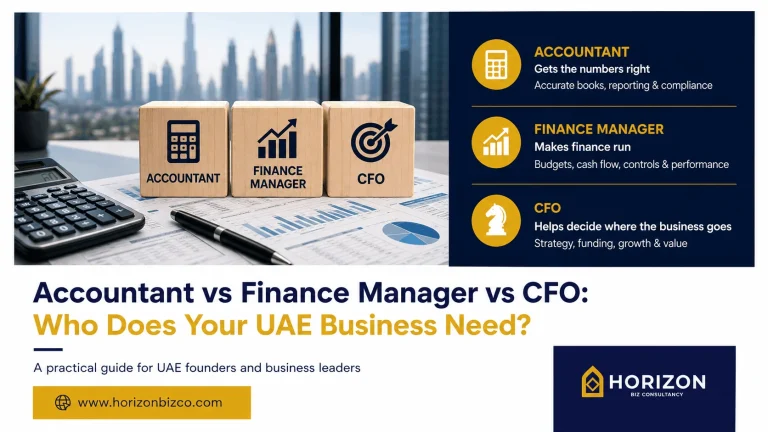
A practical guide for UAE founders and business leaders
| Hire an accountant when you need trustworthy books. Hire a finance manager when you need finance to run on time and under control. Add CFO-level support when leadership needs help deciding how to fund, protect or grow the business. |
Hiring the most senior title is not automatically the right answer. The better question is: which financial problem is currently slowing down the business?
Start with a sound accounting foundation. Under the UAE Commercial Companies Law, companies must maintain accounting records that explain their transactions and financial position, and retain those records for at least five years after the end of the financial year. For Corporate Tax, the Federal Tax Authority states that relevant records and supporting documents must generally be retained for at least seven years after the end of the relevant tax period. These duties apply to the company or taxable person. They do not create a universal rule that every UAE business must employ someone with a CFO title.
The titles can overlap, especially in smaller companies. The clearest distinction is the outcome each role is accountable for.
The simplest way to separate the three roles
| Question | Accountant | Finance Manager | CFO |
|---|---|---|---|
| Main outcome | Accurate, supportable numbers | A reliable finance operation | Better strategic decisions |
| Core focus | Books, close, records, reporting support | Budget, cash, controls, team and reporting rhythm | Capital, risk, funding, growth and enterprise value |
| Typical horizon | Past and present | Present and near term | Future and long term |
| Best fit | The numbers are late, incomplete or unreliable | The books are sound, but finance is reactive | Major decisions need senior financial judgment |
1. Accountant: gets the numbers right
An accountant creates the financial foundation on which every other finance decision depends.
Typical work
- Maintain the general ledger, reconcile accounts and support the month-end close.
- Prepare financial statements, schedules and evidence for management, auditors and tax work.
- Maintain accounts payable, accounts receivable and fixed-asset records, depending on the team structure.
- Support VAT and Corporate Tax compliance with accurate underlying data and documentation.
You probably need this role when
- The owner does not trust the profit, cash or receivables numbers.
- Management accounts are late or do not exist.
- Audit or tax information has to be assembled at the last minute.
- Transactions are increasing, but the bookkeeping process has not kept pace.
What this role should not be expected to solve: An accountant should not automatically be expected to lead funding negotiations, expansion modelling or acquisition strategy. Some accountants can do this, but it is a capability question, not a title assumption.
2. Finance Manager: makes finance run
A finance manager turns accurate accounting into a dependable operating system for the business.
Typical work
- Own the monthly reporting timetable, budgets, forecasts and management packs.
- Manage cash flow, working capital, collections and payment planning.
- Build controls, improve processes and supervise the accounting team or outsourced provider.
- Explain performance by product, branch, project, customer or cost centre so managers can act.
You probably need this role when
- The books are mostly accurate, but reports arrive too late to guide decisions.
- Cash is tight despite reported profit, or collections regularly miss plan.
- The founder approves every payment and still lacks visibility.
- The business now has multiple entities, locations, revenue lines or finance staff to coordinate.
What this role should not be expected to solve: A finance manager may support strategy, but the role is usually centred on execution, control and near-term performance. If the company faces a funding round, acquisition or major capital decision, CFO-level judgment may still be needed.
3. CFO: helps decide where the business goes
A CFO uses financial insight to shape direction, allocate capital and protect enterprise value.
Typical work
- Advise the owner, CEO or board on growth choices, risk, capital allocation and financial trade-offs.
- Lead funding strategy and senior conversations with banks, investors and other capital providers.
- Model expansion, pricing, restructuring, acquisitions, disposals and other high-impact scenarios.
- Set finance priorities and ensure reporting, controls and talent can support the business plan.
You probably need this role when
- The business is raising capital, refinancing debt or preparing for investor scrutiny.
- Leadership is entering a new country, launching a major business line or considering an acquisition or sale.
- Board reporting and financial risk have become material to the company’s future.
- The CEO needs a senior counterpart who can challenge assumptions and convert strategy into financial choices.
What this role should not be expected to solve: A CFO is not a substitute for clean books. If the accounting base is unreliable, even the best strategic model will produce weak decisions.
Who should you hire right now?
Use these four questions in order:
| 1. Are the books complete, timely and reliable? If not, start with an accountant or a strong outsourced accounting provider. |
| 2. Are cash, budgets, reporting and finance processes under control? If not, add a finance manager or an outsourced finance management layer. |
| 3. Do upcoming decisions involve funding, expansion, M&A, major risk or the board? If yes, add CFO-level support. |
| 4. Did you answer yes to more than one gap? Build a finance stack. An accountant supplies reliable data, a finance manager creates control, and a CFO turns both into strategic decisions. |
Full-time, outsourced or fractional?
There is no universal UAE revenue threshold that determines the right title. Transaction volume, reporting complexity, funding plans, regulation, business model and the frequency of senior decisions matter more than turnover alone.
Outsourced accountant: A practical fit when transaction volume is manageable and the business does not need a full-time finance employee.
In-house accountant: Useful when daily transaction processing, operational coordination and rapid internal access justify a dedicated role.
Finance manager: Best when finance needs weekly ownership, cross-team coordination and a consistent management reporting cycle. The role may be internal or outsourced, depending on complexity.
Fractional or outsourced CFO: Suitable when strategic finance work is important but does not require an executive every day.
Full-time CFO: Appropriate when group complexity, capital activity, board needs, risk or major transactions require continuous executive finance leadership.
Three expensive hiring mistakes
Hiring a CFO to repair basic bookkeeping: Senior advice cannot compensate for missing reconciliations, poor data or an undisciplined close.
Expecting an accountant to be the company’s capital strategist: You may get accurate reports without the commercial challenge needed for a funding or expansion decision.
Adding a finance manager before fixing the data: The manager ends up supervising unreliable numbers instead of improving performance.
Frequently asked questions
Does every UAE business legally need a CFO?
No universal requirement in the UAE rules cited in this guide says every ordinary business must employ a CFO. The legal and tax obligations sit with the company or taxable person. Regulated entities and particular licence types may face additional governance requirements, so confirm the rules that apply to your entity.
Can a finance manager act as a CFO?
Sometimes. A capable finance manager may take on CFO-level work in a smaller company. The test is whether the person has the authority and experience to advise on capital, risk and strategy, not whether the title has changed.
Do you still need an accountant if you have a CFO?
Yes, either in-house or outsourced. CFO decisions depend on accurate accounting. Combining roles may work in a small business, but responsibilities and review controls should remain clear.
When does a fractional CFO make sense?
When strategic decisions are significant but periodic. Examples include a financing process, expansion plan, turnaround, acquisition review or board reporting cycle that does not yet require a full-time executive.