

The UAE’s e-Invoicing mandate has created uncertainty among business owners who need clear, accurate guidance on timelines and requirements. A common misconception is that July 2026 is a universal mandatory go-live date it is not. July 2026 is the start of a voluntary pilot phase. The Federal Tax Authority (FTA) and Ministry of Finance (MoF) have set out a phased, revenue-based rollout running from mid-2026 through late 2027, governed by Federal Decree-Law No. 17 of 2025, Ministerial Decision No. 243 of 2025, Ministerial Decision No. 244 of 2025, and the amending Ministerial Decision No. 56 of 2026.
This guide reflects the current, officially confirmed timeline including the ASP appointment deadline extension to 30 October 2026 and the penalty amounts actually set out in Cabinet Decision No. 106 of 2025.
What Is the FTA Timeline and Phase-Wise Rollout Schedule?
Unlike earlier drafts of this guide (and much of the outdated content still online), the UAE mandate is not structured around six revenue tiers with a universal July 2026 deadline. The confirmed structure is:
1 July 2026 – Pilot programme begins. Open to a selected Taxpayer Working Group and any business that wants to adopt voluntarily.
Phase 1 (mandatory) – Businesses with annual revenue ≥ AED 50 million must appoint an Accredited Service Provider (ASP) by 30 October 2026 (extended from the original 31 July 2026 deadline via Ministerial Decision No. 56 of 2026) and must go live by 1 January 2027.
Phase 2 (mandatory) – Businesses with annual revenue below AED 50 million must appoint an ASP by 31 March 2027 and must go live by 1 July 2027.
Government entities – Must appoint an ASP by 31 March 2027 and go live by 1 October 2027.
The mandate also carries a limited set of scope exemptions confirmed in the Ministerial Decisions: government transactions carried out in a sovereign capacity, certain financial services supplies, and certain airline services are currently excluded. B2C (business-to-consumer) transactions are also excluded from the mandate until further notice. No further exemptions are expected.
The system operates on a decentralised 5-corner model: invoices are issued in the structured PINT AE (Peppol International Invoice – UAE) XML format, validated and transmitted through an FTA-accredited ASP, and reported to the FTA in near real time.
How Are the Implementation Phases Structured?
| Phase | Timeline / Go-Live | Target Businesses | Key Requirements | ASP Appointment Deadline |
| Pilot / Voluntary Phase | From 1 July 2026 | Taxpayer Working Group members + any business adopting voluntarily | Optional early integration, testing environment access | Not required (voluntary) |
| Phase 1 (Mandatory) | Go-live 1 January 2027 | Businesses with annual revenue ≥ AED 50 million | Full ASP integration, structured e-invoice (PINT AE) issuance, real-time FTA reporting | 30 October 2026 (extended from 31 July 2026) |
| Phase 2 (Mandatory) | Go-live 1 July 2027 | Businesses with annual revenue below AED 50 million | Standard ASP integration, structured e-invoice issuance | 31 March 2027 |
| Government Entities | Go-live 1 October 2027 | Federal and local government bodies | Sector-specific ASP integration | 31 March 2027 |
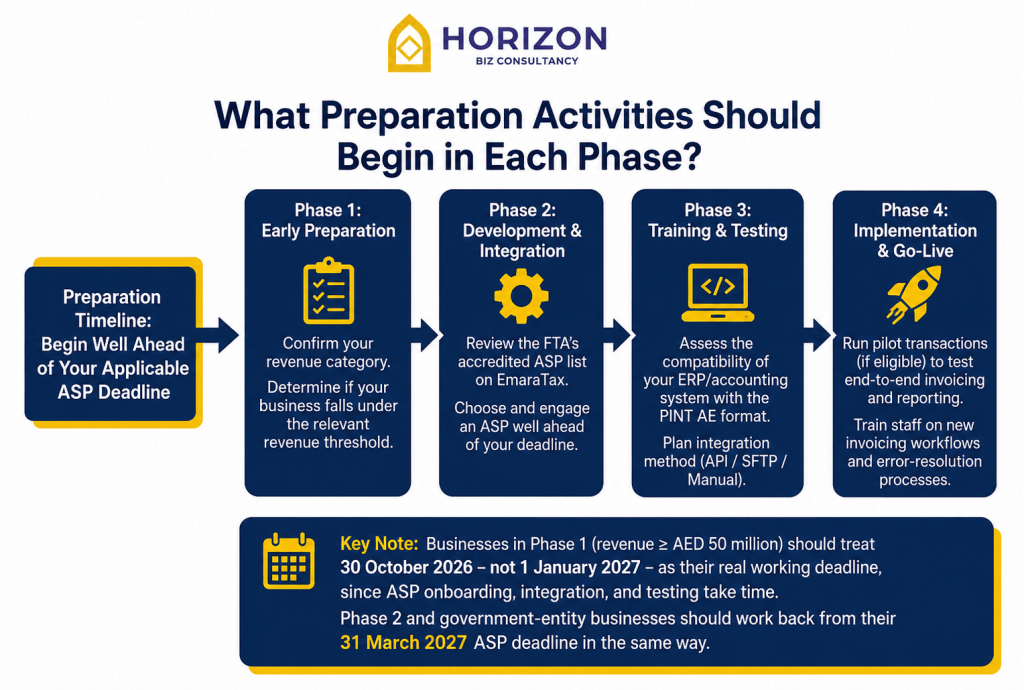
What Preparation Activities Should Begin in Each Phase?
Preparation should begin well ahead of your applicable ASP deadline and includes: confirming your revenue category, reviewing the FTA’s accredited ASP list on EmaraTax, assessing ERP/accounting system compatibility with the PINT AE format, running pilot transactions if eligible, and training staff on the new invoicing and error-resolution workflows.
Businesses in Phase 1 (revenue ≥ AED 50 million) should treat 30 October 2026 not 1 January 2027 as their real working deadline, since ASP onboarding, integration, and testing take time. Phase 2 and government-entity businesses should work back from their 31 March 2027 ASP deadline in the same way.
How Does the FTA Support Businesses During Each Phase?
The FTA and MoF provide phase-specific support, including published Electronic Invoicing Guidelines (currently Version 1.1, issued 1 June 2026), a public list of accredited ASPs, and a testing environment during the voluntary pilot period.
What Are the Mandatory vs Voluntary Compliance Periods?
Voluntary adoption is available now (from 1 July 2026) for any business ahead of its mandatory deadline. Businesses using the system voluntarily are exempt from Cabinet Decision No. 106 of 2025 penalties until e-invoicing becomes mandatory for them.
How Do Voluntary and Mandatory Periods Work?
| Compliance Type | Duration | Business Benefits | Requirements | Support Available |
| Voluntary Pilot / Early Adoption | From 1 July 2026 until your mandatory go-live date | Early testing, no penalty exposure, competitive readiness | Optional compliance; partial or full implementation | Access to FTA testing environment, technical guidance |
| Phase 1 Mandatory Compliance | From 1 January 2027 | Legal requirement fulfilled | Full ASP integration, real-time reporting; revenue ≥ AED 50M | Standard FTA support; Cabinet Decision 106 penalties apply from this date |
| Phase 2 Mandatory Compliance | From 1 July 2027 | Legal requirement fulfilled | Full ASP integration; revenue below AED 50M | Standard FTA support; Cabinet Decision 106 penalties apply from this date |
| Post-Implementation | Ongoing after go-live | Continuous improvement, optimisation | Maintained compliance with any future ASP/format updates | Ongoing FTA guidance and enhancement updates |
What Advantages Do Businesses Gain from Early Voluntary Adoption?
Early voluntary adoption gives businesses time to test ASP integration, train staff, identify ERP gaps, and avoid the compressed onboarding window that Phase 1 businesses now face given the shortened gap between the 30 October 2026 ASP deadline and the 1 January 2027 go-live date.
What Penalties Apply During Mandatory Compliance Periods?
Penalties are set out in Cabinet Decision No. 106 of 2025, effective from each business’s mandatory compliance date. They apply only once a business enters its mandatory phase; voluntary adopters are exempt.
| Violation | Penalty |
| Failing to implement the e-invoicing system or appoint an ASP within the required timeframe | AED 5,000 per month (or part thereof), accumulating until resolved |
| Failing to issue or transmit an electronic invoice within the required timeframe | AED 100 per invoice, capped at AED 5,000 per month |
| Failing to issue or transmit an electronic credit note within the required timeframe | AED 100 per credit note, capped at AED 5,000 per month |
| Failing to notify the FTA of a system malfunction within the required timeframe | AED 1,000 per day (or part thereof) |
These figures replace any earlier unofficial escalation claims (e.g., generic “annual” penalty totals not tied to the Cabinet Decision). Note that e-invoicing penalties can also combine with separate VAT administrative penalties if e-invoicing failures also cause VAT reporting errors.
How Does Business Size Categorization Affect Implementation Deadlines?
Categorization is based primarily on annual revenue, using VAT registration details and financial statements, and determines whether a business falls into Phase 1 (≥ AED 50 million) or Phase 2 (below AED 50 million).
What Technical Infrastructure Requirements Must Businesses Meet?
Businesses need systems capable of generating invoices in the PINT AE structured XML format, integrating with an FTA-accredited ASP, and supporting delivery to buyers via the Peppol network, alongside standard security, storage, and connectivity safeguards.
What Are the Core Infrastructure Components?
| Infrastructure Component | Minimum Requirements | Recommended Specifications | Business Size Considerations |
| System Integration | ASP connectivity, PINT AE-compliant invoice generation | Real-time processing, automated workflows | Scales with transaction volume |
| Security Infrastructure | Encryption, authentication | Multi-layer security, monitoring | Enhanced for larger businesses |
| Data Storage | Structured databases, backup systems | Redundancy, disaster recovery | Capacity matches business size |
| Network Connectivity | Reliable internet, bandwidth | High-availability connections | Redundancy for critical operations |
| Processing Capacity | Transaction handling capability | Scalable processing power | Matches peak transaction loads |
How Should Businesses Plan Their Infrastructure Upgrades?
Start with a current-system assessment against PINT AE and ASP-connectivity requirements, then phase upgrades to align with your applicable ASP appointment deadline and go-live date, allowing time for testing during the voluntary pilot window if eligible.
What Staff Training and Change Management Is Required?
Training should cover structured invoice generation, ASP error-resolution procedures, system-failure notification timeframes (to avoid the AED 1,000/day penalty), and general change adaptation for finance and operations teams.
What Vendor (ASP) Selection and Implementation Support Options Are Available?
Only FTA-accredited Service Providers (ASPs) may validate and transmit e-invoices on a business’s behalf. The FTA publishes an approved ASP list via EmaraTax, and businesses should select and formally appoint their ASP ahead of their applicable deadline.
How Should Businesses Evaluate E-Invoicing Solution Providers?
| Evaluation Criteria | Key Considerations | Assessment Methods | Decision Factors |
| FTA Accreditation | Confirmed presence on the FTA’s approved ASP list (EmaraTax) | Direct verification on EmaraTax | Mandatory requirement |
| Integration Capabilities | ERP/system compatibility, PINT AE support | Technical assessment, pilot testing | Implementation feasibility |
| Support Services | Onboarding, training, troubleshooting | Service level agreements, references | Long-term partnership |
| Scalability | Growth accommodation, feature expansion | Capacity testing, roadmap review | Future business needs |
| Cost Structure | Implementation, licensing, ongoing fees | Total cost analysis, ROI calculation | Budget alignment |
What Implementation Support Services Should Businesses Expect?
Support should include ASP onboarding assistance, technical integration, staff training, testing support during the voluntary pilot period, and go-live assistance aligned to your Phase 1 or Phase 2 deadline.
Conclusion
The UAE’s e-invoicing mandate is a phased rollout, not a single July 2026 deadline. Phase 1 businesses (revenue ≥ AED 50 million) must appoint an ASP by 30 October 2026 and go live by 1 January 2027; Phase 2 businesses (revenue below AED 50 million) must appoint an ASP by 31 March 2027 and go live by 1 July 2027; government entities must appoint an ASP by 31 March 2027 and go live by 1 October 2027. Voluntary adoption is open now and carries no penalty exposure, while Cabinet Decision No. 106 of 2025 sets clear, capped penalties (AED 5,000/month, AED 100/document up to AED 5,000/month, and AED 1,000/day for unreported system failures) once a business’s mandatory phase begins.
FAQ’s
As early as possible relative to your applicable deadline. Phase 1 businesses (revenue ≥ AED 50 million) should treat 30 October 2026 as their working deadline for ASP appointment, given the shortened runway to the 1 January 2027 go-live date. Phase 2 and government-entity businesses should work back from 31 March 2027.
Yes. The voluntary pilot phase started 1 July 2026, and voluntary adopters are exempt from Cabinet Decision No. 106 of 2025 penalties until their mandatory date.
Penalties under Cabinet Decision No. 106 of 2025 apply: AED 5,000/month for failing to implement or appoint an ASP, AED 100 per invoice/credit note (capped at AED 5,000/month), and AED 1,000/day for unreported system failures.
Primarily by annual revenue, verified against VAT registration and financial statements, which determines whether you fall into the ≥ AED 50 million (Phase 1) or below AED 50 million (Phase 2) category.
Standard FTA guidance, published Electronic Invoicing Guidelines, and access to the approved ASP list via EmaraTax. Phase 2 businesses have a confirmed ASP appointment deadline of 31 March 2027, ahead of the 1 July 2027 go-live date.
No. The mandate does not use a formal “SME” classification. Categorization is based solely on annual revenue: Phase 1 covers businesses with revenue of AED 50 million or more, and Phase 2 covers those below that threshold (where “SME” is used informally in general commentary, it typically refers to Phase 2 businesses).
Scope is also shaped by transaction type, not just business size: e-invoicing currently applies to B2B and B2G transactions, while B2C sales are excluded from the mandate until further notice. This means a business selling exclusively to end consumers (B2C) is not required to issue e-invoices for its outgoing sales. However, if that business procures goods or services from other UAE businesses (B2B), it is still required to register for e-invoicing on the EmaraTax portal and appoint an ASP to receive incoming structured e-invoices. A business is only completely exempt from appointing an ASP if it exclusively sells B2C and procures solely from individual consumers or through imports.
Cross-border transactions are treated differently depending on whether they are imports or exports.
Exports: Exports of goods and services are fully within the scope of the mandate. Even though they are taxed at a 0% VAT rate (zero-rated), a UAE business issuing invoices for exports must still generate them as structured e-invoices and transmit them through their ASP using the applicable zero-rated tax category under PINT-AE.
Imports: Imports of goods and services are currently out of scope for UAE e-invoicing. The official MoF guidelines align with existing VAT legislation to exclude the requirement of electronic documents to validate the import of concerned goods and/or services. Because the foreign supplier is outside the UAE jurisdiction, they are not part of the UAE’s Peppol network and cannot issue a PINT-AE XML invoice. Therefore, for imports where the UAE buyer accounts for VAT under the reverse charge mechanism, the transaction sits outside the e-invoicing mandate.
Cross-border transactions are treated differently depending on whether they are imports or exports.
Exports: Exports of goods and services are fully within the scope of the mandate. Even though they are taxed at a 0% VAT rate (zero-rated), a UAE business issuing invoices for exports must still generate them as structured e-invoices and transmit them through their ASP using the applicable zero-rated tax category under PINT-AE.
Imports: Imports of goods and services are currently out of scope for UAE e-invoicing. The official MoF guidelines align with existing VAT legislation to exclude the requirement of electronic documents to validate the import of concerned goods and/or services. Because the foreign supplier is outside the UAE jurisdiction, they are not part of the UAE’s Peppol network and cannot issue a PINT-AE XML invoice. Therefore, for imports where the UAE buyer accounts for VAT under the reverse charge mechanism, the transaction sits outside the e-invoicing mandate.
The UAE uses a decentralised 5-corner model built on the Peppol network. The supplier (Corner 1) issues the invoice through their ASP (Corner 2), which transmits it to the buyer’s ASP (Corner 3), which then delivers it to the buyer (Corner 4). Both ASPs independently report the transaction data to the FTA (Corner 5) in near real time. For cross-border transactions, invoices are routed through international Peppol network nodes to reach ASPs and buyers outside the UAE.