
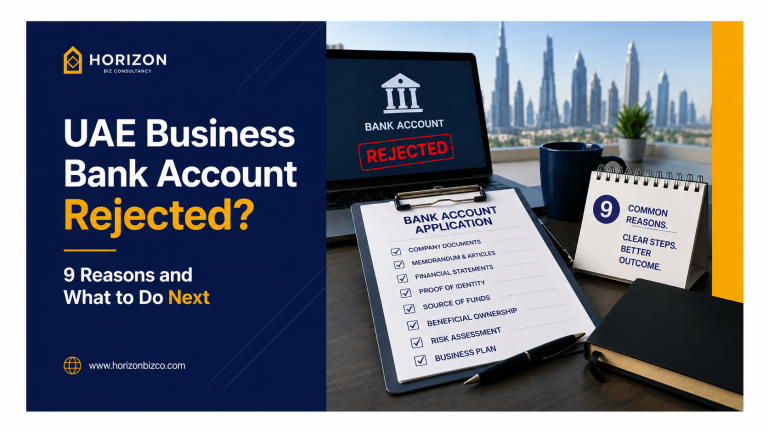
| A UAE business bank account application is commonly declined when the bank cannot get comfortable with the company’s identity, ownership, business purpose, source of funds, expected activity, supporting documents or fit with that product’s risk criteria. A decline is not proof of wrongdoing, but another application is not guaranteed to succeed. First confirm the status, identify the likely evidence gap, correct the file and reapply only when every document tells the same accurate story. |
A trade licence proves that a company has been established and authorised for stated activities. It does not require a bank to open an account for that company.
The Central Bank of the UAE describes customer due diligence, or CDD, as an ongoing, risk-based process. Before onboarding, a licensed financial institution should verify the customer and related parties, understand the business and expected transactions, and assign a risk profile. If the institution cannot complete the required CDD or identifies a confirmed sanctions match, current CBUAE guidance says it should not onboard the customer.
Source: CBUAE Guidance for LFIs on Customer Due Diligence, KYC and Recordkeeping, 6 November 2025
That regulatory framework explains why a bank may ask for much more than a licence and passport. It does not reveal the reason for any individual decision. Only the bank can clarify what it is willing and permitted to share about a specific application.
First, confirm what has actually happened
Founders often call every delay a rejection, but the next step depends on the status.
| Status | What it usually means | Best immediate response |
|---|---|---|
| More information requested | The application remains open, but the bank needs documents or an explanation. | Answer the exact request, label every attachment and reconcile it with the original application. |
| Pending or manual review | The file is still being assessed or escalated internally. | Ask for status and outstanding items. Do not submit a duplicate application unless instructed. |
| Declined or closed | The bank has decided not to open that account through that application. | Ask what category of issue can be shared and whether corrected reapplication is permitted. |
| Existing account restricted or closed | This is not an account-opening rejection and may raise different contractual or compliance issues. | Use the bank’s formal channel promptly and obtain specialist advice where needed. |
| Important A bank may provide only a broad explanation. Do not pressure staff to disclose confidential monitoring or reporting information. Ask for practical clarification: what is missing, whether a correction is allowed and whether the product is suitable for the stated activity. |
9 reasons a UAE business bank account may be rejected
The reasons below are diagnostic categories, not a claim about your bank’s private decision. More than one can apply to the same file.
1. The documents are incomplete, expired or inconsistent
Why it matters: Banks must identify and verify the legal entity, relevant individuals and authorised signatories using reliable information. A small inconsistency can also make the rest of the file harder to trust.
What may be weak in the file
- A trade licence, passport, Emirates ID or address document has expired.
- Names, dates, addresses, ownership percentages or signatures differ across forms and corporate documents.
- The board resolution, power of attorney or signing authority is missing, incomplete or inconsistent with the application.
- Foreign corporate documents are not supplied in the form, certification or translation requested by the bank.
What to do next
- Request the exact product checklist and create a one-page document index.
- Reconcile names, dates, addresses, ownership and signing powers line by line before resubmitting.
- Explain genuine differences, such as a renewed passport or address change, and attach supporting evidence.
- Do not assume a document accepted by one bank will meet another bank’s format requirements.
2. The licensed activity does not match the real business model
Why it matters: The bank needs to understand what the company will actually do. A mismatch can suggest that the account may be used for activity outside the stated licence or outside the bank’s expectations.
Common red flags in your application
- The licence says consultancy, but the application describes buying and selling goods.
- The website, company profile, contracts and application use different descriptions of the offer.
- Projected payments relate to products, markets or services not explained by the licensed activity.
How to fix this
- Write one accurate description covering what is sold, to whom, how delivery works and how the company earns revenue.
- Make the application, website, company profile, contracts and transaction forecast consistent with the facts.
- If the intended activity is not permitted by the current licence, obtain company formation or legal advice before applying again. Do not solve a licensing problem with different wording.
3. The business narrative is vague or contradictory
Why it matters: A generic description such as ‘consulting’ or ‘general trading’ does not help the bank assess customers, suppliers, delivery, markets, revenue or transaction risk.
Common red flags in your application
- The business plan is a template that could describe almost any company.
- The founder explains the model differently in the form, interview and follow-up email.
- The stated customers, revenue model or UAE rationale are not supported by commercial evidence.
What to do next
- Prepare a concise business narrative: offer, target customer, acquisition channel, delivery model, pricing, suppliers, countries and reason for banking in the UAE.
- Add real evidence, such as signed contracts, letters of intent, proposals, purchase orders, invoices or supplier arrangements where available.
- Use estimates for a new company only when clearly labelled and explain the assumptions behind them.
4. The ownership or control structure is unclear
Why it matters: CBUAE guidance requires banks to identify beneficial owners and trace ownership through legal entities to natural persons. Unusual or unnecessarily complex ownership can also trigger enhanced review.
Typical gaps in evidence
- The shareholder register, licence, incorporation documents and application do not agree.
- A corporate shareholder is shown, but the ownership chain stops before the ultimate individuals are identified.
- Control rights, nominee arrangements, trusts, powers of attorney or authorised signatories are not explained.
How to resolve this gap
- Create a dated ownership chart showing every entity, jurisdiction and percentage up to the natural-person owners and controllers.
- Attach the supporting registers, constitutional documents and identity records for each relevant layer.
- Explain who controls the company, who may operate the account and why the structure exists commercially.
- Seek legal or compliance review if the chain includes trusts, nominees, foundations, multiple offshore layers or disputed control.
5. The source of funds or source of wealth is not supported
Why it matters: The bank may need to understand the direct origin of money entering the account and, for higher-risk relationships, how the owner accumulated the wealth behind it. A declaration without a traceable money trail may not be enough.
What kind of problem in the file
- The initial capital is described as savings, a shareholder loan or sale proceeds without supporting records.
- The amount is inconsistent with the stated occupation, business history or available statements.
- Funds pass through unrelated third parties or several accounts without a clear explanation.
Recommended next steps
- Show the chain from the economic event to the account: agreement or underlying record, bank receipt, holding account and proposed transfer.
- For a shareholder loan, provide the executed agreement, lender identity, lender funding evidence and bank trail requested by the bank.
- For savings, salary, dividends, business sale, property sale or inheritance, provide the relevant records and statements requested for the case.
- Do not create a retrospective story or move funds merely to make the trail look simpler.
6. The expected transaction profile is unclear or implausible
Why it matters: CBUAE guidance says banks should collect and assess expected account activity, including anticipated values, volumes, products and geographies. The bank later monitors actual activity against that profile.
What kind of error in the file
- The form gives round figures with no calculation or link to contracts and forecasts.
- The expected currencies, countries or payment directions conflict with the stated customer base.
- A new microbusiness forecasts high monthly volumes, cash activity or rapid cross-border flows without evidence.
- The applicant cannot identify typical payers, beneficiaries, payment purpose or transaction frequency.
The solution
- Prepare a twelve-month transaction map with monthly ranges, number of payments, average values, currencies, countries and main counterparty types.
- Tie the forecast to pricing, capacity, signed work, pipeline and supplier terms. Mark assumptions clearly.
- Explain cash, third-party payments, refunds, pass-through funds or cross-border flows rather than hiding them.
- Select a product that genuinely supports the required currencies, locations and payment types.
7. There is too little verifiable evidence of genuine operations
Why it matters: The bank needs enough information to understand the purpose and intended nature of the relationship. For a new company, the evidence may be forward-looking, but it still needs to be real and consistent.
What is not right the file
- The company has no credible website, business email, customer pipeline, supplier records or operating plan.
- Its address cannot be reconciled to the licence, lease or application.
- There is no explanation of where work happens, who performs it, or why a UAE account is needed.
How to move forward
- Provide the bank’s requested address evidence and explain whether the company uses a dedicated office, shared facility, flexi desk or remote operating model.
- Support the operating story with a professional website, domain email, proposals, contracts, staffing plan, premises records and supplier evidence where genuine.
- Explain the UAE commercial link through the actual model, such as customers, suppliers, management, employees, delivery, logistics or regulatory needs.
- Do not claim that a virtual or shared address automatically causes rejection. Address and substance assessment is bank, product and case specific.
8. The risk profile requires enhanced review or falls outside the bank’s risk appetite
Why it matters: Banks apply risk-based controls. Higher-risk industries, cash-intensive models, complex ownership, certain geographies, politically exposed persons, adverse information and sanctions exposure can require deeper review. A lawful business can still fall outside one bank’s customer acceptance policy.
What Potential issues in the file
- The activity involves large cash volumes, financial services, virtual assets, high-value trading or other heightened-risk features.
- Owners, customers, suppliers, goods or payment routes involve jurisdictions or parties that need additional screening.
- The structure is more complex than the commercial model appears to require.
- Public information conflicts with the application or creates an unresolved identity match.
Steps to correct the issue
- Disclose the real risk factors and provide the licences, policies, contracts, counterparties and transaction evidence requested.
- If a screening match appears wrong, gather identity and corporate evidence that helps distinguish the applicant from the matched party.
- Ask whether the issue is missing evidence or a product-level risk appetite mismatch. The bank may not disclose detailed screening logic.
- Obtain specialist legal or compliance advice for sanctions, PEP, regulated activity, adverse information, unexplained funds or account-exit issues.
9. The company has applied for the wrong product or channel
Why it matters: A company can be legitimate and well documented but still fail a particular product’s eligibility, ownership, currency or transaction criteria. Published bank requirements show that these rules vary.
What Signs of a weakness in the file
- The chosen product supports domestic AED activity, but the company needs foreign currency or cross-border payments.
- The digital application channel is designed for a simpler ownership structure than the applicant has.
- Required documents, signatory residency or business-size criteria do not fit the applicant.
Actionable steps to take
- Match the business to the live eligibility page before applying: legal form, ownership layers, turnover segment, currencies, payment geography and service needs.
- Ask whether another product or assisted application channel is more suitable. Do not interpret that as a promise of approval.
- Compare current key facts statements, fees and balance requirements directly with banks before choosing.
What not to do after a rejection
- Do not submit the same documents to several banks before understanding its contradictions.
- Do not give different turnover, customer, country or source-of-funds answers to different institutions.
- Do not describe a higher-risk activity as something simpler merely to pass onboarding.
- Do not assume a personal account is an acceptable substitute for company banking. Check the account terms and obtain accounting or legal advice where needed.
- Do not pay anyone who promises guaranteed approval or claims to bypass bank compliance.
- Do not treat silence or delay as approval. Keep commercial commitments and customer payment plans realistic until the account is active.
Frequently asked questions
Does one rejection mean the company is blacklisted?
A decline from one bank does not by itself prove that a company is on a government-wide blacklist. Banks do keep internal records, screen applicants and make independent risk decisions. If the bank refers to sanctions, fraud, identity concerns, adverse information or an existing-account exit, obtain specialist advice. Avoid advisers who claim that a rejection has no possible wider significance without reviewing the facts.
Can I apply to another UAE bank immediately?
You can explore another bank’s eligibility, but sending an unchanged or contradictory file may reproduce the same problem. First preserve the original application, identify gaps, correct the evidence and confirm that the next product supports the business model and transactions.
Will the bank tell me the exact reason?
Not always. Communication varies, and the bank may provide only a broad decision or request. Ask whether the issue is eligibility, missing documents, clarification, product fit or a closed application, and whether corrected reapplication is allowed. The bank may not disclose detailed internal screening or monitoring information.
Is a UAE trade licence enough to open a business bank account?
No. A trade licence is a core company document, but banks also perform risk-based due diligence. They may need identity and ownership records, signing authority, address evidence, a clear business purpose, funding evidence, expected transaction details and product-specific documents.
Does a virtual office or flexi desk automatically cause rejection?
No universal rule supports that claim. An address or operating model may affect how easily a bank can verify the company’s presence and purpose, and requirements vary by product. Disclose the real arrangement and provide the address and operating evidence requested by the bank.
Can a company with a non-resident owner open an account?
Eligibility depends on the bank, product, ownership structure, signatories, business model and evidence. Non-residency should not be presented as an automatic approval or rejection rule. Check current product criteria and expect the bank to verify identity, ownership, purpose and activity on a risk basis.
How many months of bank statements are required?
There is no safe market-wide number. The required period depends on the bank, product and case. For example, one current Emirates NBD online business-account page asks for six months of company statements for an existing company or partner statements for a new company. Follow the exact live checklist for the product you choose.
How long should I wait before reapplying?
There is no universal waiting period. Ask whether the bank allows a corrected submission and whether a specific interval applies. The right time is when the underlying gap has been resolved and the evidence is ready, not simply when a certain number of days has passed.
Can a consultant guarantee account approval?
No. An adviser can help organise documents, test consistency, explain the business model and identify suitable products. The bank makes the final customer acceptance decision. A guarantee of approval is a warning sign.
Can I ask the same bank to reconsider?
You can ask whether a corrected application, reconsideration route or different product is available. Keep the request factual, attach only relevant evidence and explain what has changed. The bank is not required to reverse its decision.
Turn the rejection into a controlled next step
The most useful question is not ‘Which bank approves fastest?’ It is ‘What would a bank need to understand and verify about this company?’ Once ownership, purpose, funds, activity and product fit are clear, the next application becomes easier to review and less likely to contradict the last one.
Horizon Biz Consultancy supports UAE company setup and post-registration requirements, including assistance with corporate bank account opening. Support can improve preparation and coordination, but it cannot guarantee a bank’s approval.
Need help reviewing the company setup and bank-readiness file? Speak with Horizon about company setup support or read the broader guide to opening a corporate bank account in Dubai.
| Disclaimer Bank eligibility, documentation, fees, product features and risk appetite can change and vary by applicant. Verify the current requirements directly with the bank and obtain qualified advice for your circumstances. No adviser can guarantee account opening. |