

The UAE’s introduction of corporate tax has fundamentally changed the business landscape for companies operating in the Emirates. As we navigate through 2026, understanding the complete corporate tax filing process has become crucial for business owners, financial managers, and entrepreneurs. This comprehensive guide will walk you through every aspect of UAE corporate tax filing, ensuring you remain compliant while optimizing your tax obligations.
What is UAE Corporate Tax and Why Does It Matter in 2026?
The UAE Federal Corporate Tax came into effect on June 1, 2023, marking a historic shift in the country’s tax framework. This tax applies to businesses and other juridical persons on their profits, with rates varying based on the level of taxable income. For business owners in 2026, understanding this system isn’t just about compliance it’s about strategic financial planning and maintaining your competitive edge in the UAE market.
Key Changes and Updates for 2026
As we progress through 2026, several refinements and clarifications have been made to the corporate tax framework:
- Enhanced digital filing procedures through the EmaraTax portal
- Clearer guidelines for free zone entities
- Updated compliance requirements for small and medium enterprises
- Streamlined processes for tax group formations
Timeline of Corporate Tax Evolution in the UAE
Understanding the evolution of UAE’s corporate tax system helps contextualize current requirements:
- June 1, 2023: UAE Corporate Tax Law came into force (Federal Decree-Law No. 47 of 2022).
- September 30, 2025: Deadline for filing the first tax return for calendar-year entities (covering FY 2024).
- September 30, 2026: Key 2026 Deadline – Filing and tax payment due date for calendar-year entities (covering the FY 2025 tax period).
- December 31, 2026: Final date for the expiration of the Small Business Relief (SBR) framework.
- September 30, 2027: Future deadline for filing corporate tax returns for the FY 2026 tax period.
This timeline demonstrates the UAE’s commitment to implementing a robust yet business-friendly tax system that supports economic growth while ensuring fair contribution to national development.
Understanding Taxable Persons: Who Needs to File?
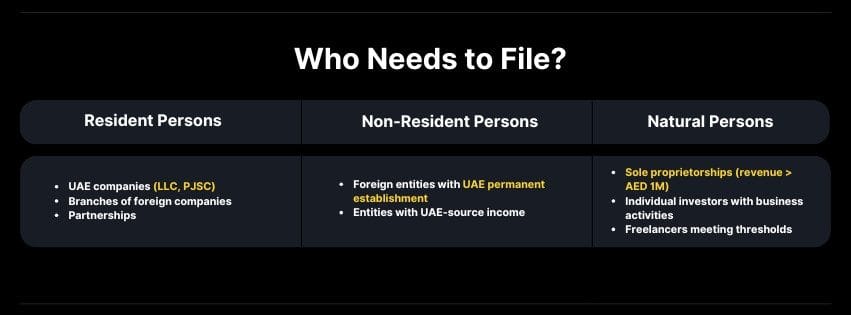
Resident Persons
A juridical person is considered a UAE resident for corporate tax purposes if it’s incorporated or established under UAE law. This includes:
- UAE companies (LLC, PJSC, private companies)
- Branches of foreign companies registered in the UAE
- Partnerships and other business entities established under UAE law
Non-Resident Persons
Foreign entities may also be subject to UAE corporate tax if they have a permanent establishment in the UAE or derive UAE-source income. This includes:
- Foreign companies with UAE branches or representative offices
- Entities conducting business through fixed places of business in the UAE
- Foreign companies earning rental income from UAE real estate
Natural Persons in Business
While individual employees typically aren’t subject to corporate tax, natural persons conducting business activities may fall under the corporate tax regime. This particularly applies to:
- Sole proprietorships with annual revenue exceeding AED 1 million
- Individual investors with significant business activities
- Freelancers and consultants meeting specific thresholds
Mandatory Corporate Tax Return Deadlines: Critical Dates You Cannot Miss
Primary Filing Deadlines
Standard Deadline: 9 months after the end of the tax period
- For calendar year entities (January-December tax period): September 30
- For entities with different year-ends: 9 months from their specific year-end date
First-Time Filers: 15 months after the end of their first tax period
- This extended deadline applies only to the very first corporate tax return
- Subsequent returns follow the standard 9-month rule
Important Pre-Filing Requirements
- For resident companies incorporated before March 1, 2024, deadlines were staggered throughout 2024 based on the month their trade license was issued.
- For companies incorporated on or after March 1, 2024, registration must be completed within 3 months of the date of incorporation.
- For natural persons (freelancers/sole proprietors), if their turnover exceeds AED 1 million in a calendar year, they must register by March 31 of the subsequent year.
- Notification of Tax Period: Required if adopting a non-calendar tax year (e.g., April to March) instead of the standard January to December period.
- Appointment of a Tax Agent: While legally optional, engaging an FTA-registered tax agent is considered best practice for handling complex calculations, transfer pricing, and free zone compliance.
Consequences of Missing Deadlines
Late filing penalties can be severe:
- Late Registration: A fixed penalty of AED 10,000 applies for missing the registration deadline.
- Late Filing: The penalty is AED 500 per month for the first 12 months of delay, increasing to AED 1,000 per month from the 13th month onwards.
- Late Payment: Unpaid corporate tax accrues a 14% per annum interest penalty, calculated monthly from the day after the payment was due.
- Potential suspension of business licenses in extreme cases
Corporate Tax Rates: Understanding Your Calculation
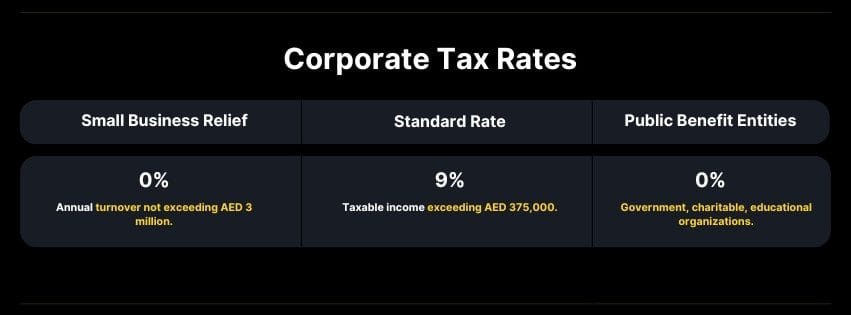
The UAE employs a tiered corporate tax structure designed to support small businesses while ensuring larger enterprises contribute appropriately:
Tax Rate Structure for 2026
Small Business Relief: 0% tax rate
- Eligibility Threshold: Applies to eligible resident businesses and natural persons whose revenue does not exceed AED 3 million in the current tax period and all prior tax periods. (Note: If your revenue exceeds AED 3 million in any single year, you permanently lose eligibility for Small Business Relief in subsequent years).
- Important 2026 Sunset Warning: Under Ministerial Decision No. 73 of 2023, Small Business Relief is a temporary provision that expires for tax periods ending after December 31, 2026. This makes 2026 the final tax period to claim SBR qualifying businesses must prepare to transition to the standard 9% corporate tax regime starting in 2027.
- Exclusions: Does not apply to Multinational Enterprises (MNE) groups or Qualifying Free Zone Persons (QFZPs).
Standard Rate: 9% tax rate
- Applies to taxable income exceeding AED 375,000
- Standard rate for most UAE businesses
- Applicable to both UAE resident and non-resident persons
Qualifying Public Benefit Entities: 0% tax rate
- Government entities
- Government-controlled entities meeting specific criteria
- Certain charitable and educational organizations
Effective Tax Rate Planning
For businesses with taxable income above AED 375,000:
- First AED 375,000: 0% tax rate
- Income exceeding AED 375,000: 9% tax rate
- This creates a progressive tax structure that supports growing businesses
Elections: Making Strategic Tax Decisions
Mandatory Elections
Tax Period Election: Choose between calendar year (January-December) or a different 12-month period
Accounting Method Election: Select cash or accrual accounting method
Functional Currency Election: Determine the currency for tax calculations
Optional Elections
Tax Group Formation: Consolidate multiple entities for tax purposes
Simplified Compliance: Available for qualifying small businesses
Installment Payment Plans: For businesses meeting specific criteria
Strategic Considerations for Elections
When making tax elections, consider:
- Your business’s cash flow patterns
- Seasonal variations in income
- Administrative burden and compliance costs
- Long-term business planning objectives
The timing of these elections is crucial, as most can only be made at specific times and may be difficult to change once implemented.
Free Zone Qualification: Navigating Special Considerations
Free Zone Person Status
Free zone entities may qualify for 0% corporate tax rate if they meet specific conditions:
Qualifying Free Zone Person Requirements:
- Maintains adequate substance in the free zone
- Only earns qualifying income
- Doesn’t elect to be subject to corporate tax
- Properly maintains books and records
Adequate Substance Requirements
To maintain free zone qualification, entities must demonstrate:
- Core income-generating activities conducted in the UAE
- Adequate number of qualified employees
- Adequate amount of expenditure incurred in the UAE
- Physical presence and operations within the free zone
Qualifying Income Definition
Free zone entities can only earn specific types of income to maintain their 0% tax status:
- Income from transactions with persons outside the UAE
- Income from transactions with other qualifying free zone persons
- Certain types of intellectual property income
- Dividends and capital gains from qualifying investments
Common Disqualifying Activities
Activities that may disqualify free zone status include:
- Significant domestic UAE transactions
- Banking, insurance, or financing activities (with exceptions)
- Natural resource extraction
- Real estate transactions within the UAE
Step-by-Step Corporate Tax Filing Process
Step 1: Pre-Filing Preparation
Gather Required Documents:
- Audited financial statements
- General ledger and supporting documentation
- Details of all income sources
- Documentation of allowable expenses
- Transfer pricing documentation (if applicable)
Verify Tax Registration Status:
- Ensure corporate tax registration is current
- Update any changes in business information
- Confirm tax agent appointments if applicable
Step 2: Calculate Taxable Income
Start with Accounting Profit:
- Begin with profit before tax from audited financial statements
- Apply UAE corporate tax adjustments
- Consider timing differences and permanent differences
Apply Specific Adjustments:
- Add back non-deductible expenses
- Subtract exempt income
- Account for depreciation differences
- Consider related party transaction adjustments
Step 3: Access the EmaraTax Portal
Login Requirements:
- Use UAE Pass or EmaraTax credentials
- Ensure you have appropriate filing permissions
- Verify entity information is current
Navigate to Corporate Tax Section:
- Select “Corporate Tax” from the main menu
- Choose “File Tax Return”
- Select the appropriate tax period
Step 4: Complete the Tax Return Form
Section A: Entity Information
- Verify all entity details are correct
- Update any changes in business activities
- Confirm contact information
Section B: Income Calculation
- Enter accounting profit/loss
- Apply all necessary adjustments
- Calculate preliminary taxable income
Section C: Deductions and Reliefs
- Claim all eligible deductions
- Apply small business relief if qualifying
- Calculate final taxable income
Section D: Tax Calculation
- Apply appropriate tax rates
- Calculate total tax liability
- Account for any tax credits or payments
Step 5: Review and Submit
Final Review Checklist:
- Verify all calculations are accurate
- Ensure supporting documents are attached
- Confirm all mandatory fields are completed
- Review summary information
Submission Process:
- Generate and review the tax return summary
- Submit electronically through the portal
- Receive confirmation and reference number
- Save submission receipt for records
Step 6: Payment Processing
Payment Methods Available:
- Online payment through EmaraTax portal
- Bank transfer to FTA account
- Payment at authorized collection centers
Payment Timing:
- Payment must be made by the filing deadline
- Late payment penalties apply if missed
- Installment plans may be available for qualifying taxpayers

Understanding Taxable Income: What Counts and What Doesn’t
Taxable Income Categories
Business Income:
- Revenue from core business activities
- Service fees and consulting income
- Rental income from business properties
- Gains from asset disposals
Investment Income:
- Dividend income (subject to participation exemption rules)
- Interest income from business investments
- Capital gains (with specific exemptions)
- Foreign income subject to UAE tax
Other Income Sources:
- Forgiveness of debt
- Government grants and subsidies (with exceptions)
- Insurance proceeds exceeding basis
- Barter transaction values
Exempt Income Categories
Dividends: Subject to participation exemption if specific conditions are met
Capital Gains: Exempt under certain circumstances, particularly for qualifying shareholdings
Government Grants: Specific exemptions for certain types of government support
Insurance Proceeds: Exempt to the extent they compensate for losses
Timing of Income Recognition
Accrual Method: Income recognized when earned, regardless of payment receipt
Cash Method: Income recognized when received (limited availability)
Specific Timing Rules: Apply to certain types of income like long-term contracts
Allowable Deductions and Expenses: Maximizing Your Tax Efficiency
Wholly and Exclusively Business Expenses
Qualifying Criteria:
- Expenses must be incurred wholly and exclusively for business purposes
- Must be supported by proper documentation
- Should be reasonable in amount and nature
Common Deductible Expenses:
- Employee salaries and benefits
- Rent and utilities for business premises
- Professional services fees
- Marketing and advertising costs
- Equipment and software expenses
- Business travel and entertainment (subject to limits)
Depreciation and Amortization
Acceptable Methods:
- Straight-line depreciation
- Accelerated depreciation for qualifying assets
- Amortization of intangible assets
Qualifying Assets:
- Plant and machinery
- Office equipment and furniture
- Vehicles used for business
- Computer equipment and software
- Buildings and improvements
Specific Deduction Limitations
Entertainment Expenses: Limited to 50% of actual costs
Penalties and Fines: Generally not deductible
Capital Expenditure: Must be depreciated rather than expensed immediately
Related Party Transactions: Subject to transfer pricing rules
Strategic Deduction Planning
Timing Considerations:
- Accelerate deductible expenses where possible
- Consider timing of asset purchases for optimal depreciation
- Plan discretionary expenses around tax year-ends
Documentation Requirements:
- Maintain detailed records of all expenses
- Ensure proper supporting documentation
- Implement robust expense approval processes
Understanding Tax Groups and Their Implications
What is a Tax Group?
A tax group allows multiple UAE resident entities under common control to be treated as a single taxpayer for corporate tax purposes. This can provide significant administrative and financial benefits for multi-entity businesses.
Eligibility Requirements
Ownership Threshold: Parent entity must own at least 95% of each subsidiary
UAE Residency: All entities must be UAE tax residents
Common Control: Must be under common control or management
Election Timing: Group election must be made before the relevant tax period
Benefits of Tax Group Formation
Administrative Efficiency:
- Single tax return for the entire group
- Consolidated compliance requirements
- Simplified reporting processes
Financial Advantages:
- Offset losses of one entity against profits of another
- Eliminate intercompany transactions
- Optimize overall group tax position
Operational Benefits:
- Streamlined cash management
- Reduced compliance costs
- Enhanced transfer pricing flexibility
Potential Drawbacks and Considerations
Loss of Individual Entity Control: Some entities may lose independence in tax matters
Exit Complications: Leaving a tax group can be complex and costly
Joint Liability: Group members may be jointly liable for tax obligations
Administrative Requirements: Additional documentation and monitoring needed
Tax Group Management Best Practices
Regular Reviews: Continuously assess the benefits and drawbacks of group status
Documentation: Maintain comprehensive records of group structure and changes
Professional Advice: Engage tax professionals for complex group arrangements
Planning: Consider long-term business plans when making group elections
Conclusion
Successfully navigating UAE corporate tax filing in 2026 requires technical knowledge, strategic planning, and ongoing compliance attention. The system has matured with clearer guidance and streamlined processes for business owners.
Success depends on understanding your obligations, maintaining excellent records, and staying informed about regulatory developments. Corporate tax compliance isn’t just about meeting minimum requirements—it’s an opportunity to optimize your tax position while contributing to the UAE’s economic development.
By following this comprehensive guidance and partnering with experienced consultants like Horizon Biz Consultancy, you can ensure compliance while positioning your business for continued success. At Horizon Biz Consultancy, we transform complex compliance requirements into efficient, manageable processes that support your business growth.
The UAE’s corporate tax system represents a new chapter in economic development, and businesses that embrace these changes with proper planning and expert guidance will thrive in this evolved landscape.
FAQ’s
A: If your taxable income is AED 375,000 or below, you’ll pay a 0% effective tax rate. However, all companies (juridical persons) are legally required to register for corporate tax regardless of revenue. Natural persons (individuals/freelancers) only need to register if their business turnover exceeds AED 1 million in a calendar year. Both must file annual returns once registered.
A: You can absolutely file your own corporate tax return through the EmaraTax portal. The FTA does not legally mandate any business to appoint a tax agent. However, given the complexities of transfer pricing, free zone exemptions, and corporate tax adjustments, engaging an FTA-registered tax agent is highly recommended to prevent costly errors.
A: Small business relief provides a 0% tax rate for businesses with annual revenue not exceeding AED 3 million, provided they meet qualifying conditions. This relief is automatic for eligible businesses and doesn’t require a separate application.
A: :Under Cabinet Decision No. 75 of 2023 (as amended by Decision No. 10 of 2024), penalties include a fixed AED 10,000 fine for late registration. For late filing, the fine is AED 500 per month (increasing to AED 1,000 from the 13th month). Any unpaid tax accrues a late payment penalty of 14% per annum, calculated monthly. Serious non-compliance can result in additional penalties and potential business license suspension.
A: Free zone entities must maintain adequate substance, earn only qualifying income, and meet ongoing compliance requirements. They must conduct core income-generating activities in the UAE and avoid significant domestic transactions.
A: Yes, tax losses can generally be carried forward indefinitely, subject to certain conditions and restrictions. However, specific rules apply to different types of losses and business changes.
A: Maintain comprehensive records including audited financial statements, general ledgers, invoices, receipts, contracts, and supporting documentation for all transactions. Under UAE Corporate Tax Law, these records must be kept for at least 7 years from the end of the relevant tax period.