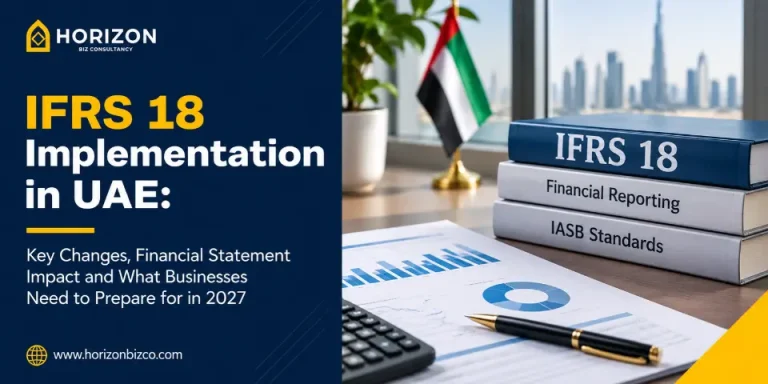
Financial reporting is about to undergo an important change, and businesses need to start paying attention. In April 2024, the IASB introduced IFRS 18, a new standard that will take the place of IAS 1 from 1 January 2027. While the change may seem like an accounting update at first, it will affect how companies present their financial results and explain their performance. For finance teams, this means there is some preparation to do before the new requirements come into effect.
For businesses in the UAE that prepare financial statements under IFRS Accounting Standards, this is an important development. The changes will affect the way income and expenses are classified, how operating performance is presented and how certain performance measures are disclosed to stakeholders.
One important distinction needs to be understood from the outset. IFRS 18 does not change how an entity recognises or measures its income, expenses, assets or liabilities under the relevant accounting standards. It changes how financial performance is presented and disclosed.
This distinction matters, particularly for CFOs, finance directors and financial controllers. The reported profit may remain unchanged, but the way that profit is presented, along with the subtotals and supporting disclosures, may look quite different.
For UAE businesses, it is worth reviewing existing financial reporting practices, accounting systems and internal management reports well before the new requirements take effect.
What Is IFRS 18 and Why Was It Introduced?
One of the reasons behind introducing IFRS 18 was the difficulty investors often faced when comparing the financial performance of different companies. Under the earlier IAS 1 requirements, businesses had a fair amount of flexibility in how they presented their income and expenses in the statement of profit or loss. While this gave companies room to present their financial results in a way that suited their operations, it did not always make comparisons easy.
Consider two businesses operating in the same industry. Both might have similar operations and financial performance, yet their financial statements could look quite different because they used different classifications for expenses, finance costs and other income. For someone reviewing these statements, understanding which business was performing better could take additional effort.
There was also the growing use of performance measures such as adjusted EBITDA and underlying profit. Companies often relied on these figures to explain their financial performance to investors and other stakeholders, but the way these measures were calculated and presented was not always consistent. IFRS 18 aims to bring greater clarity to this area.
The new standard focuses on three main areas:
- Bringing more clarity to how businesses classify and present their income and expenses in the statement of profit or loss.
- Introducing specific disclosure requirements for certain management-defined performance measures.
- Making sure financial information is grouped and presented in a way that gives investors and other users a clearer picture of the company’s performance.
IFRS 18 vs IAS 1: What Are the Major Changes?
Moving from IAS 1 to IFRS 18 will require businesses to take a closer look at how they present their financial results. One of the key changes is how income and expenses are grouped in the statement of profit or loss. Under the new standard, businesses will need to classify these items into five specific categories. Understanding where each item belongs will be an important part of getting the financial reporting process ready for IFRS 18.
1. Five Categories of Income and Expenses
The five categories under IFRS 18 are:
Operating
This is the residual category. It includes income and expenses that do not fall into the investing, financing, income taxes or discontinued operations categories.
It can include revenue, cost of sales, employee expenses, depreciation, impairment losses, restructuring costs and other operating expenses.
It is worth noting that operating profit does not necessarily represent only the income and expenses arising from a company’s regular business activities. Even costs or income that management considers unusual or one-off may still be included in this category.
Investing
The investing category covers income and expenses from certain investments and assets that can generate returns largely on their own, without depending heavily on the company’s other business activities.
Financing
The financing category covers income and expenses linked to how a business raises funds. This includes interest paid on bank loans, bonds and lease liabilities, along with certain interest-related income and expenses on other liabilities.
Income taxes
The income tax category covers tax expenses and income recognised under IAS 12, including any related foreign exchange differences.
Discontinued operations
The discontinued operations category relates to business activities that have been discontinued and are reported separately in accordance with IFRS 5.
Bringing these five categories into the statement of profit or loss should make it easier for investors and other users to understand where a company’s income comes from and how its expenses arise.
For finance teams, however, getting the classification right will require more than looking at the account name in the general ledger. They will need to understand the nature of each transaction, including the asset or liability involved, before deciding where the related income or expense should be reported.
2. Two New Mandatory Subtotals
Another important change is the introduction of two subtotals that businesses will be required to present in their statement of profit or loss.
Operating Profit or Loss
This figure brings together all income and expenses classified under the operating category. It gives financial statement users a defined starting point for understanding the results of a company’s operating activities.
Profit or Loss Before Financing and Income Tax
This subtotal starts with operating profit or loss and adds the income and expenses classified under the investing category. It provides another useful measure of financial performance before financing and income tax items are taken into account.
Businesses should also take a closer look at the profit figures they currently use in their internal reports. The operating profit presented under IFRS 18 may not match the figures management is used to seeing, particularly where the company uses its own definition of operating profit or EBITDA. Finance teams will need to understand where these differences come from and how the existing figures relate to the new presentation.
3. New Disclosure Requirements for Management-Defined Performance Measures
It is also common for companies to report financial measures that go beyond the figures required under IFRS. Adjusted EBITDA and underlying profit are two familiar examples.
IFRS 18 brings some of these measures under closer scrutiny through a new disclosure category called Management-defined Performance Measures (MPMs).
An MPM is generally a subtotal of income and expenses that management uses in public communications outside the financial statements to communicate its view of an aspect of the financial performance of the entity as a whole, and which is not otherwise specified or required by IFRS Accounting Standards.
Where a measure meets this definition, the entity must provide the required disclosures in a single note to the financial statements.
These include:
- An explanation of what the measure communicates and why management considers it useful.
- How the measure is calculated.
- A reconciliation with the most directly comparable IFRS subtotal or total.
- The income tax effect and the effect on non-controlling interests of the reconciling items.
Companies will need to identify which of their existing performance measures fall within this definition and provide the required explanations and reconciliations in their financial statements.
4. Improved Aggregation and Disaggregation of Financial Information
IFRS 18 also strengthens the principles governing how financial information is grouped and presented.
Businesses need to consider whether the way they currently group income and expenses gives readers enough information to understand the company’s financial performance.
For example, presenting several unrelated expenses under a broad heading such as other expenses may not always provide sufficient information to users of financial statements.
The new requirements place greater emphasis on meaningful descriptions, appropriate grouping and clear presentation.
This may require finance teams to review existing financial statement templates, reporting schedules and supporting information.
5. Additional Expense Disclosures by Nature
IFRS 18 introduces additional disclosure requirements for specified expenses by nature.
These include:
- Depreciation
- Amortisation
- Employee benefits
- Impairment losses and reversals
- Inventory write-downs and reversals
The information must be disclosed for the relevant categories in the statement of profit or loss.
This is particularly relevant for businesses that currently present operating expenses by function, such as cost of sales, distribution expenses and administrative expenses.
Finance teams will need to make sure the underlying information is available to prepare these additional disclosures.
How Will IFRS 18 Impact Business Financial Statements?
The practical impact of IFRS 18 will depend on how a business currently prepares its financial statements, the nature of its activities and the way management monitors financial performance.
There are several areas that deserve particular attention.
Changes to operating profit presentation
Income and expenses previously presented under different headings may be classified differently under the new requirements.
This could affect how operating profit is presented and interpreted by management, lenders, investors and other stakeholders.
Changes to accounting systems and general ledger structures
A simple mapping of existing ledger accounts may not be sufficient.
Consider an organisation that records all impairment losses under a single general ledger account. Under IFRS 18, impairment relating to operating assets may be classified in the operating category, while impairment relating to specified investments may fall within the investing category.
The business may need more detailed account structures or additional reporting information to support the required classification.
Changes to management reporting
Many organisations prepare internal reports using their own definitions of operating profit, adjusted EBITDA and other financial indicators.
These reports may need to be reviewed to ensure management understands the differences between internal performance measures and the subtotals required by IFRS 18.
Changes to financial reporting processes
The additional disclosures will require finance teams to collect, validate and reconcile information that may not currently be available in the required format.
This could involve changes to reporting responsibilities, consolidation processes and financial statement preparation procedures.
IFRS 18 Impact Across Different Industries
Although IFRS 18 applies common presentation principles, its practical application can differ depending on an organisation’s business activities.
The following examples illustrate areas that different types of UAE businesses may need to examine.
Manufacturing and Trading Businesses
Manufacturing and trading companies typically have significant operating expenses, including raw materials, inventory costs, employee benefits, depreciation and distribution expenses.
These businesses should review how operating expenses are presented, particularly where they currently use a function-based presentation.
They should also assess whether their accounting systems can provide the additional information required for disclosures of specified expenses by nature.
For companies with substantial property, plant and equipment, the classification of depreciation and impairment-related expenses will also need attention.
Retail and Distribution Businesses
Retail and distribution businesses often present expenses according to functions such as cost of sales, selling expenses and administrative expenses.
IFRS 18 requires careful consideration of whether presenting expenses by nature, function or a combination of both provides the most useful structured summary.
Where expenses are presented by function, additional disclosures will be required for specified expenses by nature.
Retail businesses should also review inventory-related expenses and write-downs to ensure the information required for the new disclosures is available.
Real Estate and Property Businesses
Real estate businesses may have different reporting considerations depending on whether they develop properties, hold investment properties, manage properties or undertake a combination of these activities.
For example, income and expenses from investment properties that generate returns independently of the entity’s other resources will generally fall within the investing category.
However, an entity that invests in such assets as a main business activity may be subject to different classification requirements.
This distinction is important for property investment companies and businesses with substantial investment property portfolios.
Financial Services and Investment Companies
Financial institutions and investment businesses require particular attention because providing financing to customers or investing in assets may form part of their main business activities.
IFRS 18 includes specific classification exceptions for entities whose main business activities include these activities.
Consequently, certain income and expenses that would normally be classified under investing or financing may instead be presented within operating profit.
Management will need to assess its main business activities using the relevant requirements and supporting evidence. The conclusion should not be based simply on how the business describes itself. The entity must consider its actual activities and the evidence available.
Professional and Service Businesses
Professional services and other service-based businesses may have relatively straightforward operating activities, but they should not assume that IFRS 18 will have limited implications.
Employee benefits, depreciation, lease-related interest and other expenses may require closer examination.
Businesses should also review how they present operating expenses and whether their existing reporting systems can provide the additional disclosures required under IFRS 18.
What Should UAE Companies Do Before IFRS 18 Becomes Effective?
The effective date of IFRS 18 is approaching, and businesses should not leave implementation until their 2027 financial statements are being prepared.
The standard requires retrospective application in accordance with IAS 8. This means businesses must restate comparative financial information when they first apply IFRS 18.
For companies with a calendar financial year, this means the 2026 comparative information will need to be prepared under the new requirements when presenting the 2027 financial statements.
This makes early preparation particularly important.
Based on the implementation requirements, businesses should focus on the following areas.
1. Conduct an IFRS 18 impact assessment
Review existing financial statements and identify which income and expense items may require reclassification.
The assessment should also identify changes to existing subtotals, disclosures and reporting formats.
2. Review the chart of accounts
Assess whether the existing general ledger structure provides sufficient information to classify income and expenses correctly.
Where necessary, introduce additional account codes, reporting dimensions or supporting schedules.
3. Review management performance measures
Identify adjusted EBITDA, underlying profit and other performance measures used in public communications.
Determine which measures meet the IFRS 18 definition of MPMs and assess the information required for the new disclosures.
4. Assess accounting software and reporting systems
Review whether existing accounting software, ERP systems and consolidation tools can capture and report information in the required format.
Where changes are necessary, allow sufficient time for system updates, testing and validation.
5. Prepare comparative financial information
For calendar-year businesses, 2026 is particularly important because the comparative information presented in the first annual financial statements applying IFRS 18 will need to be restated.
Businesses should establish the appropriate reporting processes and retain the necessary supporting information.
6. Review internal reporting and financial agreements
Assess whether internal performance reports, management remuneration arrangements, loan covenants and other agreements refer to financial measures that may be affected by the new presentation requirements.
Where necessary, management should consider whether existing reporting definitions or contractual arrangements require revision.
IFRS 18 Implementation Checklist for UAE Businesses
Before transitioning from IAS 1, finance teams should consider the following checklist:
- Review existing financial statement presentation under IAS 1.
- Identify income and expenses requiring classification under IFRS 18.
- Assess the impact on operating profit and other financial subtotals.
- Identify management-defined performance measures.
- Review existing accounting systems and general ledger structures.
- Assess the additional expense disclosure requirements.
- Review internal management reporting and financial performance indicators.
- Prepare processes for restating comparative financial information.
- Train finance and accounting teams on the new requirements.
- Establish an IFRS 18 implementation and review process.
Completing this assessment will help businesses identify potential reporting gaps before the first year of mandatory application.
How Horizon Biz Consultancy Can Help
Preparing for IFRS 18 requires more than updating financial statement templates. Businesses need to understand how the new requirements interact with their existing accounting processes, financial reporting systems and management performance measures.
At Horizon Biz Consultancy, we understand the importance of accurate financial reporting and the role it plays in business decision-making and regulatory compliance.
Our accounting and financial advisory team can help businesses assess their existing reporting practices, identify areas requiring attention and plan their transition to the new financial reporting requirements.
We also conduct IFRS 18 Impact Assessment Studies to evaluate how the changes introduced by the new standard may affect an organisation or group. This assessment helps identify the changes required in existing financial reporting practices, accounting systems, performance measures and related processes, enabling businesses to plan their transition effectively.
Planning your IFRS 18 transition?
Speak with Horizon Biz Consultancy to discuss your financial reporting requirements and identify the areas your business should assess before implementation.
Contact Horizon Biz Consultancy to discuss your IFRS 18 readiness.
Frequently Asked Questions About IFRS 18
1. When does IFRS 18 become effective in the UAE?
IFRS 18 is effective for annual reporting periods beginning on or after 1 January 2027. Earlier application is permitted.
For UAE entities preparing financial statements under IFRS Accounting Standards, the effective date is relevant to their transition planning.
2. Does IFRS 18 replace IAS 1?
Yes. IFRS 18 replaces IAS 1, Presentation of Financial Statements. However, some requirements previously contained in IAS 1 have been retained, while others have been moved to IAS 8 and IFRS 7.
3. Does IFRS 18 change the way a company calculates its profit?
No. IFRS 18 primarily changes the presentation and disclosure of financial performance. It does not change the underlying recognition and measurement requirements for income, expenses, assets and liabilities.
However, the presentation of operating profit and other subtotals may change because of the new classification requirements.
4. What are the five categories under IFRS 18?
The five categories are:
- Operating
- Investing
- Financing
- Income taxes
- Discontinued operations
Income and expenses included in the statement of profit or loss must be classified into the relevant category.
5. Do UAE businesses need to restate their comparative financial statements?
Yes. IFRS 18 requires retrospective application in accordance with IAS 8.
For businesses first applying the standard in 2027, the comparative financial information for the preceding reporting period must be restated in accordance with the transition requirements.
For calendar-year businesses, this means preparing the relevant comparative information for 2026 under IFRS 18.
About Horizon Biz Consultancy
Horizon Biz Consultancy supports businesses with accounting, financial, tax and business advisory requirements. Our focus is on helping organisations understand their financial responsibilities, strengthen reporting practices and make informed business decisions.
For assistance with IFRS 18 readiness and financial reporting requirements, get in touch with our team.